Loss of faith in our ability to discern is one of the many areas we must grieve as we recover from the trauma of the ending of a relationship.
Yes, we can initially believe that we were deceived... but eventually we will recognize that we also played a part in the deception. We stopped practicing self care. We neglected our own gut reactions for so long that we lost touch with that inner voice... the one that tells us when something isn't quite right... long before the relationship with the partner began.
We learned our habit of ignoring the elephant in the room when we were kids in our family of origin. Then, when we went out looking for a mate, we took our dysfunctional self on the road. We may very well have been deceived... but we picked the deceiver because we learned to turn off our early warning system as kids.
When we begin to practice self care and discernment... learning to trust those who are actually trustworthy... we will restore our broken picker a little at a time. We didn't become broken overnight... we won't heal overnight.
Patience... it takes a long time to rebuild trust in ourselves... in our ability to discern when we are being fooled. We have to learn to trust our gut again... to get back in touch with our body and listen to it's signals. Most of life's communication (over 80%) is non verbal... our gut reads that language fluently.
Listen to it!
Showing posts with label partners. Show all posts
Showing posts with label partners. Show all posts
Tuesday, June 14, 2011


Friday, June 10, 2011
Scars, Life and Lessons
Life offers us the opportunity to learn through lessons.
When we experience loss... whether through divorce or the ending of a committed relationship... we have two choices. We can waste our time... blaming our partner for their failures... or we can invest our time... examining ourselves to make the most of the lessons presented to us from the experience.
If we choose to invest our time in bettering ourselves it doesn't excuse our partner's failures but instead gives us the chance to acquire wisdom. We open ourselves to the possibility that we played some part in the failure of our relationship. If we seek knowledge with an open mind and spirit we will be shown the area in which change is necessary. Rarely do relationships fail because of the actions of only one in the partnership. Unhealthy interactions can become habitual.
Wisdom and acceptance bring us to a place of peace... a place where we become comfortable in our own skin. Acceptance allows us to incorporate our experiences... whether positive or negative... into our sense of self.
We become more as a result of all that has happened to us in life. The whole being greater than the sum of it's parts. We may even be able to share some of our wisdom with others to help them through their pain.
When we understand why we selected our partner in the first place we give ourselves the greatest of all gifts... understanding.
Scars remind us of where we've been... they don't have to dictate where we're going.
When we experience loss... whether through divorce or the ending of a committed relationship... we have two choices. We can waste our time... blaming our partner for their failures... or we can invest our time... examining ourselves to make the most of the lessons presented to us from the experience.
If we choose to invest our time in bettering ourselves it doesn't excuse our partner's failures but instead gives us the chance to acquire wisdom. We open ourselves to the possibility that we played some part in the failure of our relationship. If we seek knowledge with an open mind and spirit we will be shown the area in which change is necessary. Rarely do relationships fail because of the actions of only one in the partnership. Unhealthy interactions can become habitual.
Wisdom and acceptance bring us to a place of peace... a place where we become comfortable in our own skin. Acceptance allows us to incorporate our experiences... whether positive or negative... into our sense of self.
We become more as a result of all that has happened to us in life. The whole being greater than the sum of it's parts. We may even be able to share some of our wisdom with others to help them through their pain.
When we understand why we selected our partner in the first place we give ourselves the greatest of all gifts... understanding.
Scars remind us of where we've been... they don't have to dictate where we're going.
Sunday, February 6, 2011
The Rules
Disagreements in relationships are normal. Life would be boring if we were all the same and agreed on everything. There would be no growth... no challenges... we would learn nothing from our interactions with one another.
Fighting... when partners follow the rules... can be productive when it's used to clear the air and settle a disagreement that is highly charged. It isn't the best way to communicate, but happens even in the best of relationships and at times is a necessary form of settling disputes... so long as partners follow the rules.
Rules:
No name calling
Stick to the subject
No bringing up past mistakes
No screaming or yelling
No disparaging remarks
No involving other parties (so and so said this or that...)
If tempers flare, take a time out and return when both parties are cool headed and centered, ready to talk
This may sound impossible...or at the very least incredibly difficult to do but it's not. It's a decision to treat your partner with the same dignity and grace... even when you're angry... that you would offer to a stranger you met in church. When partners agree to follow these rules and make it a habit... many things that should never be said... aren't. And that saves both parties a whole lot of hurt feelings and resentments.
Remember... it only gets hard to follow these rules when we are overwhelmed and out of control. If we practice self care and don't take on responsibilities that aren't ours to begin with, we will feel balanced and centered rather than used and unappreciated.
If we are feeling a great deal of resentment and anger toward our partner we may need to first do some journaling and clarify exactly what is bothering us. We then sit down with our partner when we are calm and share our feelings in a non-threatening way using "I" statements (ie: I feel ___ when you ___) instead of "you" statements (You always... you never) which communicate blame rather than feelings and put our partner on the defensive.
Learning appropriate communication isn't easy... it's a habit that needs to be repeated over and over to become a part of us... but it's so worth it. Our relationships improve dramatically when we learn to communicate in a non-threatening way. We invite our partner to share with us when we listen twice as much as we talk... thereby giving our partner a chance to share their feelings with us as well. These small changes communicate that we value our partner as equal human beings and that they are important to us.
Some of us may have learned that total honesty in a relationship included saying whatever came into our heads when we are angry or upset. This couldn't be farther from the truth. We must learn to use discernment to evaluate whether what we are feeling is accurate or not... whether what we are upset about is important in the grand scheme of things... or not... and choose our words wisely. We must remember that we are talking to someone who is our most valued and trusted friend... our best friend... and our words and actions should reflect that fact.
Always keep your words soft and sweet in case you have to eat them later.
Fighting... when partners follow the rules... can be productive when it's used to clear the air and settle a disagreement that is highly charged. It isn't the best way to communicate, but happens even in the best of relationships and at times is a necessary form of settling disputes... so long as partners follow the rules.
Rules:
No name calling
Stick to the subject
No bringing up past mistakes
No screaming or yelling
No disparaging remarks
No involving other parties (so and so said this or that...)
If tempers flare, take a time out and return when both parties are cool headed and centered, ready to talk
This may sound impossible...or at the very least incredibly difficult to do but it's not. It's a decision to treat your partner with the same dignity and grace... even when you're angry... that you would offer to a stranger you met in church. When partners agree to follow these rules and make it a habit... many things that should never be said... aren't. And that saves both parties a whole lot of hurt feelings and resentments.
Remember... it only gets hard to follow these rules when we are overwhelmed and out of control. If we practice self care and don't take on responsibilities that aren't ours to begin with, we will feel balanced and centered rather than used and unappreciated.
If we are feeling a great deal of resentment and anger toward our partner we may need to first do some journaling and clarify exactly what is bothering us. We then sit down with our partner when we are calm and share our feelings in a non-threatening way using "I" statements (ie: I feel ___ when you ___) instead of "you" statements (You always... you never) which communicate blame rather than feelings and put our partner on the defensive.
Learning appropriate communication isn't easy... it's a habit that needs to be repeated over and over to become a part of us... but it's so worth it. Our relationships improve dramatically when we learn to communicate in a non-threatening way. We invite our partner to share with us when we listen twice as much as we talk... thereby giving our partner a chance to share their feelings with us as well. These small changes communicate that we value our partner as equal human beings and that they are important to us.
Some of us may have learned that total honesty in a relationship included saying whatever came into our heads when we are angry or upset. This couldn't be farther from the truth. We must learn to use discernment to evaluate whether what we are feeling is accurate or not... whether what we are upset about is important in the grand scheme of things... or not... and choose our words wisely. We must remember that we are talking to someone who is our most valued and trusted friend... our best friend... and our words and actions should reflect that fact.
Always keep your words soft and sweet in case you have to eat them later.
Thursday, January 20, 2011
Help... I Have Made A Terrible Mistake
What happens if we leave our partner during mid life crisis only to find we made a terrible mistake?
There have been many of us who leave a long standing relationship (not always for another partner, some just for space) during mid life only to regret the decision when we realize the impact on our lives. Some of us have been fortunate enough to have sought counseling and been able to repair the rift before divorce became the only answer. Others have not been so lucky.
Looking outside ourselves for answers doesn't work. Happy isn't out there somewhere... happy is an inside job. If we aren't happy with our lives when we hit midlife it's time to reassess... not immediately look for an escape route. The level of maturity we have when midlife arrives determines how we handle it. Immature, coddled, self centered adults act out. Mature grown ups communicate.
It may be difficult or frightening to share our disappointments with our partner... but if we think clearly we will realize that they must have their own lost dreams to deal with as well. We are not the only one in the relationship. Acknowledging our limitations... becoming vulnerable... allowing ourselves to re-experience emotional intimacy... these are all paths back to wholeness.
We may have spent many years building walls instead of bridges. Our expectations must be realistic. We cannot undo what has taken years to create in a short time. Patience... hard work... honest self exploration and gentle sharing all work together to create the environment necessary to reinvent our relationship.
There have been many of us who leave a long standing relationship (not always for another partner, some just for space) during mid life only to regret the decision when we realize the impact on our lives. Some of us have been fortunate enough to have sought counseling and been able to repair the rift before divorce became the only answer. Others have not been so lucky.
Looking outside ourselves for answers doesn't work. Happy isn't out there somewhere... happy is an inside job. If we aren't happy with our lives when we hit midlife it's time to reassess... not immediately look for an escape route. The level of maturity we have when midlife arrives determines how we handle it. Immature, coddled, self centered adults act out. Mature grown ups communicate.
It may be difficult or frightening to share our disappointments with our partner... but if we think clearly we will realize that they must have their own lost dreams to deal with as well. We are not the only one in the relationship. Acknowledging our limitations... becoming vulnerable... allowing ourselves to re-experience emotional intimacy... these are all paths back to wholeness.
We may have spent many years building walls instead of bridges. Our expectations must be realistic. We cannot undo what has taken years to create in a short time. Patience... hard work... honest self exploration and gentle sharing all work together to create the environment necessary to reinvent our relationship.
Wednesday, January 5, 2011
Confessions, Betrayal and Intimacy

What do I do? My partner has had an affair which ended... has come to me to confess the betrayal... and wants to work through it in counseling to better our relationship.
We get maybe an hour to an hour and a half once a week with the counselor... let us use that time to find out what was missing in our relationship (probably emotional intimacy) that caused our partner to look elsewhere to fulfill unmet emotional needs (btw - emotional intimacy doesn't equal sex).
A fair guess is that either or both of us felt emotionally abandoned at some level long before the affair happened. If that's the case, the way to salvage the relationship and rebuild trust is to begin to give each other what was missing in the first place. People in emotionally satisfying relationships don't get involved in extramarital avenues because they aren't looking. Period. In order to avoid the trap of a repeat of the same problem later on down the line we need to create an emotionally satisfying relationship. Getting tools to accomplish that should be the focus of our counseling sessions.
We may feel that getting our questions answered will lead to figuring out why our partner looked elsewhere... to discover what was missing. But the truth is that unless each of us begins to be vulnerable to one another and risk being known with all our lumps and bumps... emotional intimacy won't be possible. The way to find out what was missing isn't by questioning... it's by being emotionally available and letting the walls down. When we do that our partner feels safe enough to finally be honest and tell us the truth.
That's a scary thing to do after all the hurt and betrayal that has happened... but if we really are serious about wanting to improve our relationship... that is the recipe my friend.
Monday, January 3, 2011
Donuts and the Truth
If you don't want the truth... don't ask me. If you want something sugarcoated... go eat a donut.
Today while surfing online I read a post that struck me. It really got me thinking... do we want to hear the truth when we come to a counselor looking for support? Or are we just there to have someone reinforce our own point of view? Are we looking for truth or validation?
Personally, I think we attend counseling to allow another to tell us the truth. It may be the awful truth... it may be something we'd rather not hear... but in the end what we really desire is for someone... anyone... to finally be 100% honest with us.
Why do I think that is the case? Because for many of us we have been deceived and manipulated by others for so long that we doubt our ability to discern the truth. We have lost our innate trust in our own gut.
It may have happened when we were kids and our parents refused to discuss the elephant in the room... an alcoholic or abusive parent or sibling for example... and we began to believe that somehow we were wrong. We saw that elephant... didn't they? Why wouldn't they talk to us about it? Why did they insist it wasn't there? Were we unable to properly distinguish reality? They are big... we are small... they know what's real... we don't. We are scared by this difference in perception. In order to feel safe we decide to believe they are right.
Here we are... many years later. We try to select a partner with whom to create a life. We pick someone who "feels right". All goes well at first... we then discover we have chosen a person who mirrors some of the same dysfunction we experienced in our childhoods. It "felt right" because as dysfunctional as our childhoods may have been... it's comfortable... familiar.
Years pass and we and our partner drift apart. We come to counseling and we vent... we cry... we allow ourselves to be seen in all our pain. We want answers. We want someone... anyone... to finally tell us why this happened in our relationship.
Finally we begin to see the truth. We are told something in counseling that infuriates us and realize we are still reacting to the same old pain. Sometimes we read a book and see ourselves in a new light. Sometimes others situations are similar and we learn from their wisdom. However it happens... we learn more about ourselves through the process.
In the end we come through the experience with new wisdom... an inner strength we never knew existed... and discover serenity and acceptance.
Today while surfing online I read a post that struck me. It really got me thinking... do we want to hear the truth when we come to a counselor looking for support? Or are we just there to have someone reinforce our own point of view? Are we looking for truth or validation?
Personally, I think we attend counseling to allow another to tell us the truth. It may be the awful truth... it may be something we'd rather not hear... but in the end what we really desire is for someone... anyone... to finally be 100% honest with us.
Why do I think that is the case? Because for many of us we have been deceived and manipulated by others for so long that we doubt our ability to discern the truth. We have lost our innate trust in our own gut.
It may have happened when we were kids and our parents refused to discuss the elephant in the room... an alcoholic or abusive parent or sibling for example... and we began to believe that somehow we were wrong. We saw that elephant... didn't they? Why wouldn't they talk to us about it? Why did they insist it wasn't there? Were we unable to properly distinguish reality? They are big... we are small... they know what's real... we don't. We are scared by this difference in perception. In order to feel safe we decide to believe they are right.
Here we are... many years later. We try to select a partner with whom to create a life. We pick someone who "feels right". All goes well at first... we then discover we have chosen a person who mirrors some of the same dysfunction we experienced in our childhoods. It "felt right" because as dysfunctional as our childhoods may have been... it's comfortable... familiar.
Years pass and we and our partner drift apart. We come to counseling and we vent... we cry... we allow ourselves to be seen in all our pain. We want answers. We want someone... anyone... to finally tell us why this happened in our relationship.
Finally we begin to see the truth. We are told something in counseling that infuriates us and realize we are still reacting to the same old pain. Sometimes we read a book and see ourselves in a new light. Sometimes others situations are similar and we learn from their wisdom. However it happens... we learn more about ourselves through the process.
In the end we come through the experience with new wisdom... an inner strength we never knew existed... and discover serenity and acceptance.
Sunday, November 21, 2010
Support - Balcony People
When our relationships hit a rough spot how do we cope? What do we do to garner support?
We reach out to those who have gone before us... counselors... friends... folks we meet in group or at meetings. We read books and articles written by those with wisdom and experience. We search our soul for realization of our part.
Relationships are like a dance... we must see our steps clearly. We must look with eyes unclouded by poor judgement and unresolved issues to see truth. It isn't easy to see our part... especially if we are hurt, sad or angry... but if we are to come through the difficult times back to a state of joy we must accept that we too have contributed to the problems we face... that our partner is not the only one to blame.
As we point our finger at our partner we realize that three fingers point right back at us. We too share in the issues... have perpetrated the hurts... have added to the pain. If we are to clear the air and begin anew we must own our part of the problem.
As we go through the toughest part of the process we know that there is light at the end of the tunnel... and it isn't an oncoming train.
Many have survived the road we are walking. They are all here with hands outstretched... reaching for us... cheering us on as we do the next right thing... as we walk the talk.
Yes, it's humbling... and jumbling too. We feel confused... angry... sad... hurt... devastated... overhwelmed... depressed... and much more. But there are so many watching us take one step at a time... praying for us... pleading with us not to give up.
They are all here along the side of the path... cheering... shouting our name in joy... waiting for us to come far enough along that we too can join on the sidelines and begin to cheer for the next one to walk this long and winding road.
They are shouting... Can you hear us? Can you see us?
We reach out to those who have gone before us... counselors... friends... folks we meet in group or at meetings. We read books and articles written by those with wisdom and experience. We search our soul for realization of our part.
Relationships are like a dance... we must see our steps clearly. We must look with eyes unclouded by poor judgement and unresolved issues to see truth. It isn't easy to see our part... especially if we are hurt, sad or angry... but if we are to come through the difficult times back to a state of joy we must accept that we too have contributed to the problems we face... that our partner is not the only one to blame.
As we point our finger at our partner we realize that three fingers point right back at us. We too share in the issues... have perpetrated the hurts... have added to the pain. If we are to clear the air and begin anew we must own our part of the problem.
As we go through the toughest part of the process we know that there is light at the end of the tunnel... and it isn't an oncoming train.
Many have survived the road we are walking. They are all here with hands outstretched... reaching for us... cheering us on as we do the next right thing... as we walk the talk.
Yes, it's humbling... and jumbling too. We feel confused... angry... sad... hurt... devastated... overhwelmed... depressed... and much more. But there are so many watching us take one step at a time... praying for us... pleading with us not to give up.
They are all here along the side of the path... cheering... shouting our name in joy... waiting for us to come far enough along that we too can join on the sidelines and begin to cheer for the next one to walk this long and winding road.
They are shouting... Can you hear us? Can you see us?
Wednesday, November 17, 2010
Taking Poison - Resentment & Bitterness
How do we cope with angry feelings in our partnership? What can we do to keep those angry feelings from becoming resentment or bitterness?
After reading a thoughtfully written quote it occurred that resentment and bitterness are one of the most important topics in relationships. The quote basically said, "Resentment is like taking poison and waiting for the other person to die."
What a concept... we want to be compassionate in our relationships. We want to be loving and filled with warmth. But what happens when our trust is violated in some way and we feel the sting of betrayal. How do we cope with our feelings without becoming bitter and resentful?
One of our most basic tools is counseling. We must choose to avail ourselves of assistance when we face a situation that we cannot handle with the tools we currently possess. We may need a safe place to express our anger... to work through our feelings... so that we don't poison our relationship. If our partner has betrayed us in some way we have a choice to make. Is this betrayal a deal breaker? Or do we and our partner want to salvage the relationship?
Contrary to what others in our lives may believe there is no right answer for this question. Each partnership is unique. What works for one may not work for another. Partners must decide how much of a commitment they have made to the relationship and what they are willing to do to work through the issues that present themselves. For some, betrayal of any kind is more than they are willing to forgive. For others there is compassion and forgiveness. Neither are right... just different.
When we arrive at a decision with our partner and the help of a counselor, giving our best efforts to the situation is imperative. Anger is an appropriate emotion following betrayal. It requires a safe environment in which to be expressed. Once the anger has been fully explored and the underlying issues revealed healing can begin.
Avoiding resentment and bitterness may take a great deal of effort, but in the long run it is worth the work... our relationship and our health depend upon it.
After reading a thoughtfully written quote it occurred that resentment and bitterness are one of the most important topics in relationships. The quote basically said, "Resentment is like taking poison and waiting for the other person to die."
What a concept... we want to be compassionate in our relationships. We want to be loving and filled with warmth. But what happens when our trust is violated in some way and we feel the sting of betrayal. How do we cope with our feelings without becoming bitter and resentful?
One of our most basic tools is counseling. We must choose to avail ourselves of assistance when we face a situation that we cannot handle with the tools we currently possess. We may need a safe place to express our anger... to work through our feelings... so that we don't poison our relationship. If our partner has betrayed us in some way we have a choice to make. Is this betrayal a deal breaker? Or do we and our partner want to salvage the relationship?
Contrary to what others in our lives may believe there is no right answer for this question. Each partnership is unique. What works for one may not work for another. Partners must decide how much of a commitment they have made to the relationship and what they are willing to do to work through the issues that present themselves. For some, betrayal of any kind is more than they are willing to forgive. For others there is compassion and forgiveness. Neither are right... just different.
When we arrive at a decision with our partner and the help of a counselor, giving our best efforts to the situation is imperative. Anger is an appropriate emotion following betrayal. It requires a safe environment in which to be expressed. Once the anger has been fully explored and the underlying issues revealed healing can begin.
Avoiding resentment and bitterness may take a great deal of effort, but in the long run it is worth the work... our relationship and our health depend upon it.
Thursday, November 11, 2010
HELP - My Expectations Are Killing Me!!
How do we manage our expectations in a healthy way? Can our expectations cause us problems in our relationship?
Expectations can be a double edged sword. At times we gain power and insight from the expectations we have of ourselves. But what about the expectations we have of our partner? How do they affect our relationship?
If we expect our partner to fulfill our expectations we may be placing undue pressure on both our partner and our relationship. We hold the responsibility to fulfill our own expectations. When we give that power away, we lose the ability to practice self care. We give control of ourselves and our happiness over to another. When we do that we may be setting ourselves up for disappointment.
As much as our partner may wish to please us and may make every effort to act in our best interest, there will be times when their desires and ours will not overlap. If we have placed our expectations in their hands we will surely be disappointed and possibly hurt. If we have, instead, taken responsibility for our own expectations we will be assured that we remain in balance regardless of what our partner is or is not doing at the moment.
In a healthy relationships partners make every effort to be compassionate, respectful and considerate of one another. We do not feel the need to meet each others expectations as we know that we are responsible for meeting our own. In this way we assure that we remain balanced, emotionally available and connected in our lives and in our relationships.
Expectations can be a double edged sword. At times we gain power and insight from the expectations we have of ourselves. But what about the expectations we have of our partner? How do they affect our relationship?
If we expect our partner to fulfill our expectations we may be placing undue pressure on both our partner and our relationship. We hold the responsibility to fulfill our own expectations. When we give that power away, we lose the ability to practice self care. We give control of ourselves and our happiness over to another. When we do that we may be setting ourselves up for disappointment.
As much as our partner may wish to please us and may make every effort to act in our best interest, there will be times when their desires and ours will not overlap. If we have placed our expectations in their hands we will surely be disappointed and possibly hurt. If we have, instead, taken responsibility for our own expectations we will be assured that we remain in balance regardless of what our partner is or is not doing at the moment.
In a healthy relationships partners make every effort to be compassionate, respectful and considerate of one another. We do not feel the need to meet each others expectations as we know that we are responsible for meeting our own. In this way we assure that we remain balanced, emotionally available and connected in our lives and in our relationships.
Wednesday, November 10, 2010
Moving Beyond Betrayal
How do we move past the pain and loss of betrayal? Can we salvage our relationship or is betrayal the kiss of death?
Not all betrayal involves emotional or physical affairs. Some betrayal involves more subtle violations that can occur slowly and painfully over many years. Drug and alcohol abuse can fall into this category, as can gambling or any other addiction.
The first step in determining whether we can move beyond betrayal is to determine why our partner strayed from their promises in the first place. This may be an area requiring the assistance of a counselor. We may be unable to figure out what was lacking either in our partner or in our relationship without help. We must keep in mind that some betrayal occurs because of a issue within our partner... and some occurs because of an issue within the relationship. To avoid a repeat of the problem, discerning the underlying cause is paramount.
Once we have clarified why the betrayal happened we will be able to determine if a repair of the relationship is possible or desirable. At this point we have the information we need to make an informed decision. We must decide if the betrayal is a deal breaker... or just an issue needing work than can be healed by time and effort.
Some relationships rebound from betrayal with increased intimacy and trust... others dissolve. It is our decision based upon the information we have gathered that will determine which outcome is best for our particular situation. All relationships are unique. A counselor can assist in clarifying the issues present and in facilitating communication, but only the partners involved can decide what is best for their situation.
Reaching out for help when relationships falter can save partners from a future of pain or bring one of joy.
Not all betrayal involves emotional or physical affairs. Some betrayal involves more subtle violations that can occur slowly and painfully over many years. Drug and alcohol abuse can fall into this category, as can gambling or any other addiction.
The first step in determining whether we can move beyond betrayal is to determine why our partner strayed from their promises in the first place. This may be an area requiring the assistance of a counselor. We may be unable to figure out what was lacking either in our partner or in our relationship without help. We must keep in mind that some betrayal occurs because of a issue within our partner... and some occurs because of an issue within the relationship. To avoid a repeat of the problem, discerning the underlying cause is paramount.
Once we have clarified why the betrayal happened we will be able to determine if a repair of the relationship is possible or desirable. At this point we have the information we need to make an informed decision. We must decide if the betrayal is a deal breaker... or just an issue needing work than can be healed by time and effort.
Some relationships rebound from betrayal with increased intimacy and trust... others dissolve. It is our decision based upon the information we have gathered that will determine which outcome is best for our particular situation. All relationships are unique. A counselor can assist in clarifying the issues present and in facilitating communication, but only the partners involved can decide what is best for their situation.
Reaching out for help when relationships falter can save partners from a future of pain or bring one of joy.
Monday, May 3, 2010
How Do I Move Past the Anger?
How do I move past the anger I feel toward my former abusive partner?
The reason a former partner still acts hostile and nasty toward us is because we escaped their abuse. They feel resentment toward us because they still feel some level of involvement.
They enjoy poking at us and trying to get our goat... it's sadly part of the personality of someone who is abusive... it's their way of trying to control us.
We need to learn how to unplug those buttons that they push. That takes work and help... it's not something we will likely be able to accomplish alone. If we don't have a counselor we need to find someone who specializes in abuse and recovery. That is where we will find the tools we need to move past the anger and bitterness.
As long as we continue to hate the abuser we are tying ourselves to them emotionally. Hate and love are the opposite of the same emotion. When our feelings evolve into indifference we will have moved past our own attachment and their antics will appear humerous to us... much like a cartoon character.
Anger does nothing to help in the process. It eats away at our insides and can turn into resentment and bitterness. Compassion is the answer... feeling empathy for their inability to move past their own dysfunction and disease which locks them in their own cycle of pain.
Luckily for us, we don't have to participate in that cycle any longer... but they still do. It's within them and they have no where to run... changing partners doesn't solve the problem because the problem is within them. Seeing the situation is that light helps. It gives us the ability to see past our own anger and see them for the small person they really are...
Dysfunctional and diseased.
The reason a former partner still acts hostile and nasty toward us is because we escaped their abuse. They feel resentment toward us because they still feel some level of involvement.
They enjoy poking at us and trying to get our goat... it's sadly part of the personality of someone who is abusive... it's their way of trying to control us.
We need to learn how to unplug those buttons that they push. That takes work and help... it's not something we will likely be able to accomplish alone. If we don't have a counselor we need to find someone who specializes in abuse and recovery. That is where we will find the tools we need to move past the anger and bitterness.
As long as we continue to hate the abuser we are tying ourselves to them emotionally. Hate and love are the opposite of the same emotion. When our feelings evolve into indifference we will have moved past our own attachment and their antics will appear humerous to us... much like a cartoon character.
Anger does nothing to help in the process. It eats away at our insides and can turn into resentment and bitterness. Compassion is the answer... feeling empathy for their inability to move past their own dysfunction and disease which locks them in their own cycle of pain.
Luckily for us, we don't have to participate in that cycle any longer... but they still do. It's within them and they have no where to run... changing partners doesn't solve the problem because the problem is within them. Seeing the situation is that light helps. It gives us the ability to see past our own anger and see them for the small person they really are...
Dysfunctional and diseased.
Sunday, March 28, 2010
$9 Million Awarded to Betrayed Partner From Paramour
Is it an effective remedy to award monetary damages from the paramour to the betrayed partner?
People betray others in relationships. This is a fact that is not new to mankind. Betrayal is not limited to adultery... there are plenty of ways to betray one's partner. This particular monetary award is about adultery.
When we seek out counseling we almost never talk about our own involvement in the betrayal. We are obsessed with blame and anguish. It is expected and understandable... we are suffering with extreme levels of pain and loss.
As time passes and the hurt begins to heal, our ability to see our own piece in the puzzle, no matter how tiny, begins to clarify. It is at this point that we start to have the ability to let go of the pain and loss and true healing can begin.
What happens when we never let go of the pain and loss? We stay angry. Over time that anger hardens into bitterness and resentment. Bitter resentful people don't move on from living in the past. We don't enjoy the present because we are too busy embracing our righteous path of constantly remembering how we were wronged.
One who pursues this type of monetary reward is still living with their focus in the past. There may be a real need for funds... that is not the issue. There are many ways to get the funds that have been awarded and not paid via family court routes. This award is about punishment and retribution.
My question is... when this case is over and the betrayed partner has collected whatever they get of the $9 Million...
Will they then live in the present?
Will they then feel happy?
Will they then be a whole person?
I think not... they will still feel the bitterness and resentment that they have chosen to focus on for so long... because money can't fix that.
Money is a tool. It can be used for constructive or destructive purposes.
It has no intrinsic value of it's own.
People betray others in relationships. This is a fact that is not new to mankind. Betrayal is not limited to adultery... there are plenty of ways to betray one's partner. This particular monetary award is about adultery.
When we seek out counseling we almost never talk about our own involvement in the betrayal. We are obsessed with blame and anguish. It is expected and understandable... we are suffering with extreme levels of pain and loss.
As time passes and the hurt begins to heal, our ability to see our own piece in the puzzle, no matter how tiny, begins to clarify. It is at this point that we start to have the ability to let go of the pain and loss and true healing can begin.
What happens when we never let go of the pain and loss? We stay angry. Over time that anger hardens into bitterness and resentment. Bitter resentful people don't move on from living in the past. We don't enjoy the present because we are too busy embracing our righteous path of constantly remembering how we were wronged.
One who pursues this type of monetary reward is still living with their focus in the past. There may be a real need for funds... that is not the issue. There are many ways to get the funds that have been awarded and not paid via family court routes. This award is about punishment and retribution.
My question is... when this case is over and the betrayed partner has collected whatever they get of the $9 Million...
Will they then live in the present?
Will they then feel happy?
Will they then be a whole person?
I think not... they will still feel the bitterness and resentment that they have chosen to focus on for so long... because money can't fix that.
Money is a tool. It can be used for constructive or destructive purposes.
It has no intrinsic value of it's own.
Wednesday, March 24, 2010
What Kind of Relationship Do I Have?
What kind of relationship do I have? There are different types of attachments that partners tend toward in relationships.
Dependent: partners may become enmeshed within the relationship and with one another, losing their individuality in the process and making their lives smaller. Dependent partners bring little new life to the relationship and may gradually become like a sponge, absorbing energy and vitality from the relationship and giving little in return. Dependent partners may be frightened of individual growth and may try to prevent it within themselves and their partner, thereby suffocating both their partner and the relationship in the process.
Independent: partners may not form attachments properly in independent relationships... they may live separate lives focused mainly on their own pursuits, interests and achievements. The relationship may be for status, financial reasons, or to have the correct partner for social functions. Rarely is there a significant amount of emotional intimacy between the two. The relationship may not foster attachment and may dissolve if one of the partners becomes emotionally involved with another party.
Codependent: the partnership may be unbalanced... with one of the partners needs dominating the relationship and the other partner functioning as one who services the needs of the other. Often times the partner who services feels used and alone, frequently complaining of being ignored, unheard and not validated. The partner being serviced may be completely unaware that there is any problem, as they may tend to be self absorbed. These relationships may eventually become hotbeds of anger and frustration. Partners may burn out due to excessive care taking or a build up of resentment and bitterness.
Interdependent: partners are committed to one another, yet are each others cheerleaders for individual growth and exploration. Individuation is not seen as a threat, but as an expression of growth necessary for both the individuals and the partnership to remain healthy and balanced. Each of the partners brings their individual growth back to the partnership, enriching it in the process. These partnerships may be quite long lasting and healthy, as the partners are encouraged to pursue their own interests and lives adding to the value of the relationship.
What type of relationship do you have?
Dependent: partners may become enmeshed within the relationship and with one another, losing their individuality in the process and making their lives smaller. Dependent partners bring little new life to the relationship and may gradually become like a sponge, absorbing energy and vitality from the relationship and giving little in return. Dependent partners may be frightened of individual growth and may try to prevent it within themselves and their partner, thereby suffocating both their partner and the relationship in the process.
Independent: partners may not form attachments properly in independent relationships... they may live separate lives focused mainly on their own pursuits, interests and achievements. The relationship may be for status, financial reasons, or to have the correct partner for social functions. Rarely is there a significant amount of emotional intimacy between the two. The relationship may not foster attachment and may dissolve if one of the partners becomes emotionally involved with another party.
Codependent: the partnership may be unbalanced... with one of the partners needs dominating the relationship and the other partner functioning as one who services the needs of the other. Often times the partner who services feels used and alone, frequently complaining of being ignored, unheard and not validated. The partner being serviced may be completely unaware that there is any problem, as they may tend to be self absorbed. These relationships may eventually become hotbeds of anger and frustration. Partners may burn out due to excessive care taking or a build up of resentment and bitterness.
Interdependent: partners are committed to one another, yet are each others cheerleaders for individual growth and exploration. Individuation is not seen as a threat, but as an expression of growth necessary for both the individuals and the partnership to remain healthy and balanced. Each of the partners brings their individual growth back to the partnership, enriching it in the process. These partnerships may be quite long lasting and healthy, as the partners are encouraged to pursue their own interests and lives adding to the value of the relationship.
What type of relationship do you have?
Monday, March 22, 2010
It's Okay for Me to Have Needs Too?
My partner seems to forget special occasions... I feel badly yet I don't say anything about it. Should I mention it... or is it unimportant? I feel appreciated and loved all the rest of the days... am I being petty? What should I do?
We can be applauded for handling forgetfulness in a classy way. We save our partner from feeling shamed by not making a fuss when an occasion is accidentally forgotten. It is all right to forget occasionally. However, if forgetting becomes a pattern in a relationship, there is generally more going on than just an accidental lapse with regard to a date or event.
It is not uncommon to have a partner who forgets occasions. We all get the same excuses... I forgot... I didn't have time... I was busy with xyz... The truth is that we all have the same twenty four hours each day. What we do with that time is a display of what we value.
We may go through many, many occasions with us being the one to let it go until we realize that we also have needs and that it's okay to ask to have those needs met. Yes, our partner is wonderful and shows love every day in many different ways. If this one way is important to us - and it may be - then why should we discount ourselves? Our partner enjoys receiving recognition on important occasions... why not us too?
After a pattern of forgetting develops, we can have a chat with our partner. We can share that we would prefer a blank card with a picture that means something to us both... something from the heart written inside... rather than an elaborate gift. Remembrances don't have to be expensive or complex... they allow us to feel valued on days that are special to us.
Sharing how important this is to us and being vulnerable, we allow our partner to feel safe enough to share whatever the underlying issue may be. After listening and empathizing, we reassure our partner... whatever efforts they can make... whatever is on their heart... they can feel comfortable acknowledging occasions... knowing that their efforts will be appreciated.
It can work out well for both parties. We can learn to communicate our needs and in the process both we and our partner get validated. When a partner is reluctant to do something simple - like acknowledging an occasion - there is usually a deeper issue at the heart of the resistance. Eventually as partners feel safe with one another, they will share their fears and reluctance, thereby overcoming the obstacles keeping them from intimacy.
We can be applauded for handling forgetfulness in a classy way. We save our partner from feeling shamed by not making a fuss when an occasion is accidentally forgotten. It is all right to forget occasionally. However, if forgetting becomes a pattern in a relationship, there is generally more going on than just an accidental lapse with regard to a date or event.
It is not uncommon to have a partner who forgets occasions. We all get the same excuses... I forgot... I didn't have time... I was busy with xyz... The truth is that we all have the same twenty four hours each day. What we do with that time is a display of what we value.
We may go through many, many occasions with us being the one to let it go until we realize that we also have needs and that it's okay to ask to have those needs met. Yes, our partner is wonderful and shows love every day in many different ways. If this one way is important to us - and it may be - then why should we discount ourselves? Our partner enjoys receiving recognition on important occasions... why not us too?
After a pattern of forgetting develops, we can have a chat with our partner. We can share that we would prefer a blank card with a picture that means something to us both... something from the heart written inside... rather than an elaborate gift. Remembrances don't have to be expensive or complex... they allow us to feel valued on days that are special to us.
Sharing how important this is to us and being vulnerable, we allow our partner to feel safe enough to share whatever the underlying issue may be. After listening and empathizing, we reassure our partner... whatever efforts they can make... whatever is on their heart... they can feel comfortable acknowledging occasions... knowing that their efforts will be appreciated.
It can work out well for both parties. We can learn to communicate our needs and in the process both we and our partner get validated. When a partner is reluctant to do something simple - like acknowledging an occasion - there is usually a deeper issue at the heart of the resistance. Eventually as partners feel safe with one another, they will share their fears and reluctance, thereby overcoming the obstacles keeping them from intimacy.
Sunday, March 21, 2010
Why Don't I Feel For My Partner Any Longer?
What happened to the feelings we used to have for one another in our relationship? Where did they go? Can we get back to a place where we can feel that way again?
We must try to understand that our feelings didn't just vanish overnight. They faded away a little at a time over the years as we and our partner built walls not bridges, with the communications we shared. Those walls are made of bricks crafted of disappointment, bitterness, resentments, hurts, loss, pain, rejection and uncertainty.
Since it took years to create those walls we cannot expect them to come down quickly. The mortar that holds those bricks together is formed from defense mechanisms that each of us have learned during our time together to protect ourselves from further pain and loss.
The reason we don't "feel anything" for our partner right now, is because we have experienced so much pain, loss and disappointment... that our defense mechanisms have sprung up to protect us... in this way we don't feel anything at all... we're numb.
It's easier to be numb than to feel pain. But remember, numb means we don't feel joy (or love) either. In order to begin to "feel" for our partner again, we are going to have to experience the backlog of frozen feelings that we have been avoiding through being numb. Once we have cleared through all that frozen pain, loss, disappointment and whatever else is in there... quite a lot of work... we will begin to experience our emotions once again.
This is not a task for the faint hearted. Facing all the "stuff" that we have denied and allowed our defenses to freeze will be a courageous experience like none other we have undertaken in our adult life.
BUT... it is a journey worth every ounce of effort. It will bring us to a place of peace unlike anything we have ever experienced. Good luck to each of us as we embark on our journey... and all our hopes that we find ourselves through this process of recovery.
We must try to understand that our feelings didn't just vanish overnight. They faded away a little at a time over the years as we and our partner built walls not bridges, with the communications we shared. Those walls are made of bricks crafted of disappointment, bitterness, resentments, hurts, loss, pain, rejection and uncertainty.
Since it took years to create those walls we cannot expect them to come down quickly. The mortar that holds those bricks together is formed from defense mechanisms that each of us have learned during our time together to protect ourselves from further pain and loss.
The reason we don't "feel anything" for our partner right now, is because we have experienced so much pain, loss and disappointment... that our defense mechanisms have sprung up to protect us... in this way we don't feel anything at all... we're numb.
It's easier to be numb than to feel pain. But remember, numb means we don't feel joy (or love) either. In order to begin to "feel" for our partner again, we are going to have to experience the backlog of frozen feelings that we have been avoiding through being numb. Once we have cleared through all that frozen pain, loss, disappointment and whatever else is in there... quite a lot of work... we will begin to experience our emotions once again.
This is not a task for the faint hearted. Facing all the "stuff" that we have denied and allowed our defenses to freeze will be a courageous experience like none other we have undertaken in our adult life.
BUT... it is a journey worth every ounce of effort. It will bring us to a place of peace unlike anything we have ever experienced. Good luck to each of us as we embark on our journey... and all our hopes that we find ourselves through this process of recovery.
Thursday, January 21, 2010
HANDBOOK FOR 2010
HANDBOOK 2010
Health:
1. Drink plenty of clean fresh water.
2. Eat breakfast like a king, lunch like a prince and dinner like a beggar.
3. Eat more foods that grow on trees and plants and eat less food manufactured in plants.
4. Live with the 3 E's -- Energy, Enthusiasm and Empathy.
5. Make time to pray.
6. Play more games
7. Read more books than you did in 2009 .
8. Sit in silence for at least 10 minutes each day
9. Sleep for at least 7 hours.
10.Take a 10-30 minutes walk daily. And while you walk... smile.
Personality:
11. Don't compare your life to others. You have no idea what their journey entails.
12. Don't invest in negative thoughts or things you cannot control. Live in the present moment.
13. Don't over do. Keep within your limits.
14. Don't take yourself so seriously. No one else does.
15. Don't waste your precious energy on gossip.
16. Dream more while you are awake
17. Envy is a waste of time. You already have all you truly need.
18. Forget issues of the past. Don't remind your partner of mistakes.
19. Life is too short to waste time hating anyone. Don't hate.
20. Make peace with your past so it won't spoil the present.
21. No one is in charge of your happiness except you.
22. Smile and laugh more.
23. You don't have to win every argument. Learn to agree to disagree.
Society:
24. Call your family often.
25. Be charitable... each day give something to others.
26. Forgive easily and anger slowly.
27. Spend time with people over 70 & under 6 whenever you can.
28. Try to make at least three people smile each day.
29. What other people think of you is less important than what you think of yourself.
30. Your job won't care for you when you are sick or lonely. Your friends will. Stay in touch.
Life:
31. Do the right thing!
32. Get rid of anything that isn't useful, meaningful or joyful.
33. Our higher power heals everything.
34. However good or bad a situation is, it will change.
35. No matter how you feel, get up, shower, get dressed and show up.
36. The best is yet to come.
37. When you awake alive in the morning, be grateful.
38. Your inner being strives to be happy. So, be happy.
39. Share your vision with others.
40. And finally... Realize that life is a school and you are here to learn. Challenges are part of the curriculum but the lessons you learn will last a lifetime.
Health:
1. Drink plenty of clean fresh water.
2. Eat breakfast like a king, lunch like a prince and dinner like a beggar.
3. Eat more foods that grow on trees and plants and eat less food manufactured in plants.
4. Live with the 3 E's -- Energy, Enthusiasm and Empathy.
5. Make time to pray.
6. Play more games
7. Read more books than you did in 2009 .
8. Sit in silence for at least 10 minutes each day
9. Sleep for at least 7 hours.
10.Take a 10-30 minutes walk daily. And while you walk... smile.
Personality:
11. Don't compare your life to others. You have no idea what their journey entails.
12. Don't invest in negative thoughts or things you cannot control. Live in the present moment.
13. Don't over do. Keep within your limits.
14. Don't take yourself so seriously. No one else does.
15. Don't waste your precious energy on gossip.
16. Dream more while you are awake
17. Envy is a waste of time. You already have all you truly need.
18. Forget issues of the past. Don't remind your partner of mistakes.
19. Life is too short to waste time hating anyone. Don't hate.
20. Make peace with your past so it won't spoil the present.
21. No one is in charge of your happiness except you.
22. Smile and laugh more.
23. You don't have to win every argument. Learn to agree to disagree.
Society:
24. Call your family often.
25. Be charitable... each day give something to others.
26. Forgive easily and anger slowly.
27. Spend time with people over 70 & under 6 whenever you can.
28. Try to make at least three people smile each day.
29. What other people think of you is less important than what you think of yourself.
30. Your job won't care for you when you are sick or lonely. Your friends will. Stay in touch.
Life:
31. Do the right thing!
32. Get rid of anything that isn't useful, meaningful or joyful.
33. Our higher power heals everything.
34. However good or bad a situation is, it will change.
35. No matter how you feel, get up, shower, get dressed and show up.
36. The best is yet to come.
37. When you awake alive in the morning, be grateful.
38. Your inner being strives to be happy. So, be happy.
39. Share your vision with others.
40. And finally... Realize that life is a school and you are here to learn. Challenges are part of the curriculum but the lessons you learn will last a lifetime.
Saturday, December 5, 2009
How Can I Get Along With Difficult People?
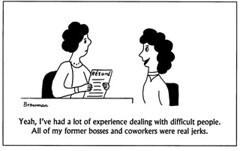
Since many of us have house guests around the holidays and want to enjoy our time with them, here is some excellent advice from Dale V. Atkins, PhD on how to get along with difficult people.
It’s inevitable that at some point we will have to spend time with people we don’t like. Maybe you don’t like your spouse’s best friend or your daughter’s boyfriend. Here are some simple guidelines for getting through these tricky situations...
YOU DON’T GET ALONG WELL WITH A RELATIVE
This is someone you can’t avoid completely but with whom you can spend only so much time before he/she starts to drive you crazy. Perhaps your sister is a slob, and you’re very tidy... or you have a parent you love, but who is overly critical.
With these people, it is best to keep activities confined to neutral zones, such as going to a movie or a restaurant. Usually, in these places, conversations don’t get too out of hand. With a movie, you’ll be able to talk only before and after, though you’re still spending time together. Also, these activities have built-in time limits, so you will be spending quality time with someone you love, but you’ll also be giving yourself an exit.
Keep in mind that while you may be tempted, it’s usually not worth your time to try to redesign someone’s personality. This almost always meets with resistance and can lead to fights. Just try to focus on the best aspects of his/her personality.
YOU DON’T LIKE YOUR PARTNER’S FRIEND
When you don’t like your partner’s friend, it can be difficult for both you and your partner. First, try your best to see things through your partner’s eyes, and try to find something you like or can appreciate about his friend. It can be something as simple as appreciating his sense of style or a joke he told once.
Let your partner know that it’s OK to do things without you, but try to attend if there’s an important event in the friend’s life -- for example, a wedding or a party for a promotion.
Never try to turn your partner against his friend. You don’t have to like him as much as your partner does, but you should respect the relationship. Don’t be rude or say nasty things about him.
YOUR PARTNER DOESN’T LIKE YOUR FRIEND
Let your partner know that it is OK to not like your friend, but it’s not OK to be rude or dismissive to him/her. Ask for the same respect to be shown to your friends that you show to your partner’s friends.
Cultivate your relationship with your friend without your partner, and don’t insist that everyone spend time together. Sometimes it’s easier to do this during the week, instead of on the weekend, when you may have family obligations.
YOU DON’T LIKE YOUR CHILD’S SPOUSE
One of the trickiest situations is when your child marries someone whom you do not like. It can be very hard to hide your feelings, but for the sake of your relationship with your child, it’s a good idea. Make every effort to get along with your child’s spouse, and do your best to care about him/her and show him respect.
Don’t say anything bad about your child’s spouse. You don’t want to put your child in the middle of a conflict between you and his spouse, and it is not fair to make your child choose between you and the spouse.
If there is a legitimate issue between you and your child’s spouse -- for example, if she is rude to you in public -- it’s best to pull her aside at another time and try to work it out.
YOU DON’T AGREE WITH A LOVED ONE’S CHOICES
It’s always hard to see someone you love making bad choices. Maybe a child is spending too much time partying at college or a friend is in a damaging relationship.
Talk to him/her in an open way, and share your concerns -- but don’t pressure and don’t be overly judgmental. Discuss with him the consequences of his actions. For example, if your child is partying at school more than studying, there is a real chance that he could flunk out.
Remember that he must choose to change -- you can’t force that on anyone. Tell him that you love him and that you always will, but that you don’t agree with his choices.
One way to reduce the stress you feel when seeing a friend or relative in situations you don’t agree with is to focus on your own wisdom and be grateful for what you have and who you are.
YOU DON’T LIKE YOUR HOUSEGUEST
Sometimes there’s no way to avoid having your castle invaded by people who get under your skin -- whether it is your partner’s old college roommate or your great-aunt Helen.
Try to carve out some time for yourself. Find something relaxing and recharging that you love to do. Take a quiet walk by yourself... have a relaxing bath... or meditate.
It may help to put your guests to work if they are staying with you for more than a few days. Having them do some dishes or fold some laundry can help to greatly reduce your own stress level. If you have less stress and less work to do, you might even enjoy your guests.
Regardless of what tools we use and how we cope we may face stress in dealing with difficult people during the holiday season. If we remember to practice self care whenever we begin to feel overwhelmed, we will be able to enjoy our family and friends and rejoice in the precious present.
Saturday, November 28, 2009
Am I a Support or a Burden?
How we cope when our partner is having a rough day is important. Are we a person who helps make the difficulties lighter? Or are we someone who drags our partner down even more when times are hard for them?
We may not always have a choice about what happens in a day, but we have a choice in how we respond to the presenting challenge. We can meet challenges with gratefulness, realizing that we are learning a necessary lesson for our or our partners growth. Or, we can meet it with angst and hostility, feeling resentment that our plans have been altered against our wishes.
How we respond when our partner is wrestling with an issue is vital. If we maintain our composure, keep our response appropriate yet positive and try to see the benefit, we can enhance our partners surroundings.
If we succumb to the temptation to wallow in self pity and regret we may add fuel to our partners fire, possibly helping to derail their attempt to maintain composure. Or, worse yet, we may become an additional challenge in their day.
The last thing we want to do is to make our partners day more difficult when they are already stressed out about a challenge they are facing. One of the purposes of a relationship is to be a support to one another when difficulties arise. Our role of supporter is never more vital than at a time when our partner is in crisis.
We use our tools to remain centered, exercise patience, exhibit compassion and offer our assistance when appropriate. In this way we allow our partner the space and time necessary to solve their own challenges, while remaining available, should the need arise for our help to be requested. In this way we give our partner the gift of support.
We may not always have a choice about what happens in a day, but we have a choice in how we respond to the presenting challenge. We can meet challenges with gratefulness, realizing that we are learning a necessary lesson for our or our partners growth. Or, we can meet it with angst and hostility, feeling resentment that our plans have been altered against our wishes.
How we respond when our partner is wrestling with an issue is vital. If we maintain our composure, keep our response appropriate yet positive and try to see the benefit, we can enhance our partners surroundings.
If we succumb to the temptation to wallow in self pity and regret we may add fuel to our partners fire, possibly helping to derail their attempt to maintain composure. Or, worse yet, we may become an additional challenge in their day.
The last thing we want to do is to make our partners day more difficult when they are already stressed out about a challenge they are facing. One of the purposes of a relationship is to be a support to one another when difficulties arise. Our role of supporter is never more vital than at a time when our partner is in crisis.
We use our tools to remain centered, exercise patience, exhibit compassion and offer our assistance when appropriate. In this way we allow our partner the space and time necessary to solve their own challenges, while remaining available, should the need arise for our help to be requested. In this way we give our partner the gift of support.
Sunday, November 15, 2009
Am I Enhancing My Relationship?
What makes one relationship work while another falters? What steps can we take to preserve our partnership?
There are habits that we can create in our relationship that may help us feel more connected with one another. These are simple choices we make each day that can make the difference between happiness and emptiness.
Going to bed at the same time each night where possible gives partners the chance to snuggle and reconnect in a physical way after a long day of being apart. Our skin responds to touch by releasing chemicals that help us relax. Snuggling may help us fall asleep more easily and feel connected in a positive way.
Having shared interests is important for us to flourish in a partnership. We bring ourselves to the relationship as a gift. If the gift we bring is filled with interests and fun we add a great deal of positive energy to our relationship. Cultivating our own lives as well as common interests is paramount to a healthy balanced partnership.
Letting our partner know that we are proud to be seen with them is vital. We show our pride in our relationship by encouraging touch when we are with others. We may hold hands, or rest our arm in theirs. We may walk with fingers entwined or lean against one another while sitting. All these gestures allow our partner to feel the sense of pride we share in our partnership.
Assume the best. When we are in a committed relationship we are bound to make mistakes as is our partner. When we begin by assuming the best we are giving our partner the benefit of the doubt. We allow ourselves to make our first priority trust and faith in our partner, that they did not intend to cause harm. If harm was caused, we display forgiveness as we would want to be forgiven when we falter.
The old saying, accentuate the positive... eliminate the negative... applies well in relationships. We tend to see the glass as either half full or half empty. If we have learned to see the world through an optimistic view we are more likely to have positive outcomes. We learn to overlook the tiny annoyances that all relationships endure and focus on the areas we enjoy in our partner. We too have annoying attributes and wish our irritations to be overlooked.
Make it a habit to check in with one another during the day. We offer our partner support, love, encouragement and allow ourselves to get a glimpse of how our partners day is progressing. This is an invaluable tool in assessing how our partner may be feeling later on in the evening. If we are aware of the stresses they have dealt with during the day we can be more prepared for their energy level later on and adjust our expectations accordingly.
Make your first encounter after a long absence, such as a day at work, positive. A smile and hug or kiss at first reunion paves the way for positive feelings they may last well into the remainder of the day. Showing our partner how pleased we are to see them again is well worth the effort.
There are habits that we can create in our relationship that may help us feel more connected with one another. These are simple choices we make each day that can make the difference between happiness and emptiness.
Going to bed at the same time each night where possible gives partners the chance to snuggle and reconnect in a physical way after a long day of being apart. Our skin responds to touch by releasing chemicals that help us relax. Snuggling may help us fall asleep more easily and feel connected in a positive way.
Having shared interests is important for us to flourish in a partnership. We bring ourselves to the relationship as a gift. If the gift we bring is filled with interests and fun we add a great deal of positive energy to our relationship. Cultivating our own lives as well as common interests is paramount to a healthy balanced partnership.
Letting our partner know that we are proud to be seen with them is vital. We show our pride in our relationship by encouraging touch when we are with others. We may hold hands, or rest our arm in theirs. We may walk with fingers entwined or lean against one another while sitting. All these gestures allow our partner to feel the sense of pride we share in our partnership.
Assume the best. When we are in a committed relationship we are bound to make mistakes as is our partner. When we begin by assuming the best we are giving our partner the benefit of the doubt. We allow ourselves to make our first priority trust and faith in our partner, that they did not intend to cause harm. If harm was caused, we display forgiveness as we would want to be forgiven when we falter.
The old saying, accentuate the positive... eliminate the negative... applies well in relationships. We tend to see the glass as either half full or half empty. If we have learned to see the world through an optimistic view we are more likely to have positive outcomes. We learn to overlook the tiny annoyances that all relationships endure and focus on the areas we enjoy in our partner. We too have annoying attributes and wish our irritations to be overlooked.
Make it a habit to check in with one another during the day. We offer our partner support, love, encouragement and allow ourselves to get a glimpse of how our partners day is progressing. This is an invaluable tool in assessing how our partner may be feeling later on in the evening. If we are aware of the stresses they have dealt with during the day we can be more prepared for their energy level later on and adjust our expectations accordingly.
Make your first encounter after a long absence, such as a day at work, positive. A smile and hug or kiss at first reunion paves the way for positive feelings they may last well into the remainder of the day. Showing our partner how pleased we are to see them again is well worth the effort.
Tuesday, November 10, 2009
Questions and Answers on Relationships
We worked through a lot of issues... Please explain... what issues have you worked through? Were they the same issues you have now? If that is so, then maybe you haven't worked through these issues.
We have no intimacy... What does intimacy mean to you? Intimacy doesn't mean sexual or physical gratification. Intimacy means allowing another person to get to know you without all the masks, roles and pretense most of us use to protect ourselves. Has your partner tried to get to know you? Have you allowed them in?
There's no passion... What is lacking here, sexual passion? Was there ever any? Is this a problem of different libidos or a problem of sexual attraction?
I'm just so worried I'm making a mistake... Maybe we are making a mistake. We have tried couples counseling for some time with little to show for it. Have we considered going to individual counseling first to sort out our own issues before we try to fix our partner? One of the first things we all learn is that if we expect our relationship to get better we have to stop trying to fix and change our partner and work on changing ourselves. Once we have worked through our own issues then we are ready to try couples work and improve our relationship. The cart before the horse rarely produces results.
I'm so bitter from the lack of love being shown me and the way I'm made to feel, like I have to beg for love... Once we become embittered and lose our ability to be compassionate toward our partner we are doing to them exactly what we feel they are doing to us. It becomes a self fulfilling cycle of victimization and punishment. We move from being the victim (such a comfy role) to being the punisher (the angry role) and build walls keeping each other out.
Nothing changes and I'm tired of hoping it will - when it seems apparent it won't... even if we could make each other happy it seems it would be both of us somehow being something were not, it would always be fake...This is the saddest comment of all... anticipating that even if our partner does change, we would still be unhappy because it wouldn't be spontaneous. The best relationships are those where both partners make a conscious decision to do the work necessary to make intimacy and passion happen. They often don't happen on their own when partners are tuckered out from working so hard and helping around the house. Partners may begin to get lazy. Instead of trying to make things better with action and effort they may resort to the lazy way of fixing things... complaining... pointing fingers... blaming... It is much harder to do the work of making the effort than it is to blame our partner. Sadly when our partner makes an effort, often we are so angry and bitter that we don't give our partner the appreciation they need to feed that effort. So, after a couple of weeks of trying and not really getting the feedback they need... they give up. No relationship stays static. It is always changing, hopefully growing, and always needs maintenance and care or it dies. How would you feel if you failed and your partner didn't give you another chance to make it right?
I love my partner, but I cant take the pain... Love isn't a feeling. Love is an action verb... it is a word that indicates a willingness to put the person we love before ourselves. Love is patient, kind, gentle, appreciative, humble, giving... when we love we allow them to fail and try again.
We have no intimacy... What does intimacy mean to you? Intimacy doesn't mean sexual or physical gratification. Intimacy means allowing another person to get to know you without all the masks, roles and pretense most of us use to protect ourselves. Has your partner tried to get to know you? Have you allowed them in?
There's no passion... What is lacking here, sexual passion? Was there ever any? Is this a problem of different libidos or a problem of sexual attraction?
I'm just so worried I'm making a mistake... Maybe we are making a mistake. We have tried couples counseling for some time with little to show for it. Have we considered going to individual counseling first to sort out our own issues before we try to fix our partner? One of the first things we all learn is that if we expect our relationship to get better we have to stop trying to fix and change our partner and work on changing ourselves. Once we have worked through our own issues then we are ready to try couples work and improve our relationship. The cart before the horse rarely produces results.
I'm so bitter from the lack of love being shown me and the way I'm made to feel, like I have to beg for love... Once we become embittered and lose our ability to be compassionate toward our partner we are doing to them exactly what we feel they are doing to us. It becomes a self fulfilling cycle of victimization and punishment. We move from being the victim (such a comfy role) to being the punisher (the angry role) and build walls keeping each other out.
Nothing changes and I'm tired of hoping it will - when it seems apparent it won't... even if we could make each other happy it seems it would be both of us somehow being something were not, it would always be fake...This is the saddest comment of all... anticipating that even if our partner does change, we would still be unhappy because it wouldn't be spontaneous. The best relationships are those where both partners make a conscious decision to do the work necessary to make intimacy and passion happen. They often don't happen on their own when partners are tuckered out from working so hard and helping around the house. Partners may begin to get lazy. Instead of trying to make things better with action and effort they may resort to the lazy way of fixing things... complaining... pointing fingers... blaming... It is much harder to do the work of making the effort than it is to blame our partner. Sadly when our partner makes an effort, often we are so angry and bitter that we don't give our partner the appreciation they need to feed that effort. So, after a couple of weeks of trying and not really getting the feedback they need... they give up. No relationship stays static. It is always changing, hopefully growing, and always needs maintenance and care or it dies. How would you feel if you failed and your partner didn't give you another chance to make it right?
I love my partner, but I cant take the pain... Love isn't a feeling. Love is an action verb... it is a word that indicates a willingness to put the person we love before ourselves. Love is patient, kind, gentle, appreciative, humble, giving... when we love we allow them to fail and try again.
Subscribe to:
Posts (Atom)









 Posts
Posts

